

When the Land Dries Up, the Wetlands Weep
Every June 17, the world observes the World Day to Combat Desertification and Drought, a United Nations call to action against the slow, silent destruction of land.
This year’s theme, “Rangelands: Recognize. Respect. Restore.”, draws attention to degraded landscapes that sustain billions of lives.
While the Philippines doesn’t experience desertification in the “desert” sense, as in the Middle East and Africa, it faces prolonged dry spells, severe water stress, and drought despite being known for its abundance of water resources.
According to the Food and Agriculture Organization of the United Nations (FAO), the country has recorded 12 droughts from 1968 to the present, occurring every 3 to 7 years. In 2024, local governments in Cagayan, Isabela, and Ilocos Norte have declared a state of calamity or emergency due to the long dry spells. And last year, a drought in Pampanga dried up a dam, revealing a 300-year-old town.
Land degradation is also a cause for concern as it aggravates the problem. With nearly 45% of the country’s arable land already moderately to severely eroded (NAP-DLDD, 2010–2020), the nation, its local government units, and communities are ill-equipped to battle the effects of climate change on the vulnerable archipelago.
Filipino farmers are on the frontlines of the effects of drying land as soil productivity and water retention capacity of arable lands drop by 30–50% (NAP-DLDD, 2010–2020).
During the recurring El Niño season, droughts compound the damage, battering farmlands, drying up rivers, and pushing communities to the edge.
The Climate Change Commission has warned that addressing land degradation is “crucial for our nation’s resilience and food security.”
While all eyes are trained on the agriculture sector during the El Niño, wetlands remain the hidden casualty.
Philippine wetlands, from Manila Bay’s mangroves to Mindanao’s Agusan Marsh, are among the country’s most vital ecosystems. They buffer floods, recharge groundwater, and sequester two to four times more carbon per hectare than terrestrial forests (Wetlands International Philippines, 2026). But as drought intensifies and land degrades, these ecosystems are disappearing.
Globally, 35% of wetlands were lost between the 1970s and 2015, three times faster than forests, and the local trend mirrors this (Ramsar Global Wetland Outlook, 2018).
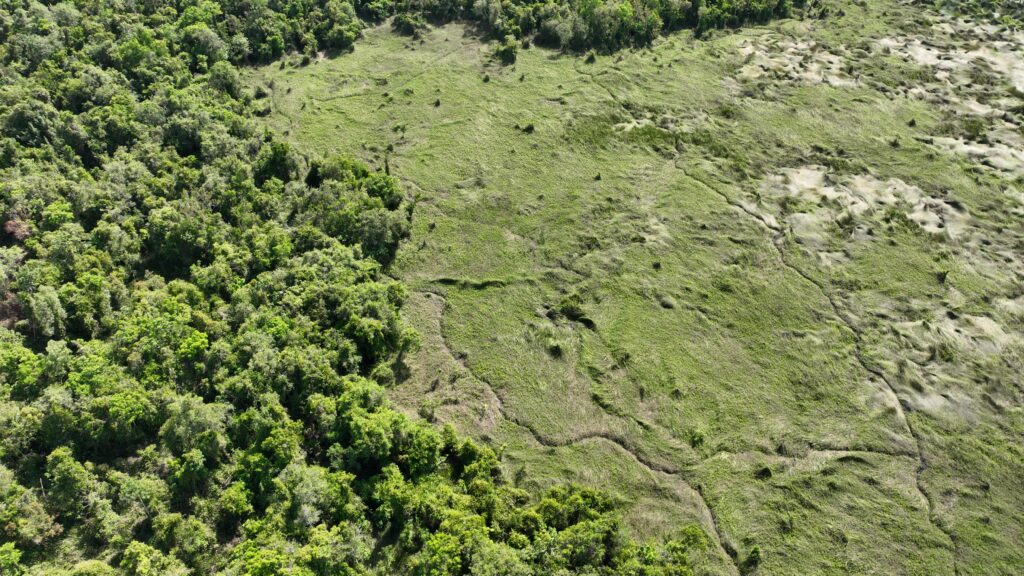
The Agusan Marsh tells the story most clearly. Home to the Manobo Indigenous community, the Philippines’ largest freshwater wetland is drying up. A people built for floods now face something harder to survive: scarcity.
“It’s drying up. That’s the whole takeaway, the scarcity of water,” one researcher told Mongabay (2023).
The Manobo are being pushed inland, displaced not by conflict, but by a degrading land and a failing water cycle.
The relationship is circular and unforgiving. Land degradation worsens drought. Drought destroys wetlands. And the loss of wetlands accelerates land degradation further. Breaking this cycle demands integrated action, not just protecting wetlands in isolation, but restoring the land around them.
Steps are being taken. The DENR’s National Blue Carbon Action Partnership, launched in 2025, works to restore mangroves, seagrasses, and tidal marshes across the archipelago.
Community-led mangrove restoration in Bataan, Iloilo, Eastern Samar, Zamboanga Sibugay, and Negros Oriental is already showing results.
The DENR is also renewing efforts to assess and identify peatlands across the country, with the Biodiversity Management Bureau reporting 29 confirmed peatlands and 83 additional areas in the process of validation. It is also working on a Manual for Sustainable Peatland Management.
But policy must be matched by public will.
This June 17, the call is clear: recognize wetlands as the lifelines they are. Key solutions include:
- Rewetting peatlands
Blocking drainage canals and restoring natural water levels keep soils wet and resilient. - Protecting remaining wetlands
Preventing further land conversion ensures wetlands continue to function as water buffers. - Promoting sustainable land use
Agroforestry and wetland-friendly agriculture reduce pressure on water systems. - Community-led management
Indigenous and local communities—like those in Agusan Marsh—hold knowledge essential for adapting to changing water cycles.
Drought in the Philippines is no longer a temporary crisis. With climate change and land-use change shaping the reality of Filipinos, the government and the people must put wetlands at the forefront of climate solutions. Healthy wetlands protect us.
The question is no longer whether drought will affect us, but whether we will invest in the natural systems that can shield us from it.
So today and in the years to come, let us restore the land with wetland-based solutions before the water runs out.
References
- Climate Change Commission Philippines. “On World Day to Combat Desertification and Drought: CCC Urges Efficient Land Restoration and Water Management.” Climate Change Commission Philippines, n.d., https://climate.gov.ph/news/892.
- Department of Environment and Natural Resources, et al. Updated Philippine National Action Plan to Combat Desertification, Land Degradation and Drought (NAP-DLDD) 2010–2020. 2010, http://philchm.ph/wp-content/uploads/The-Updated-Philippine-NAP-to-Combat-Desertification-Land-Degradation-and-Drought-DLDD-1.pdf.
- Food and Agriculture Organization. “The Philippines Case: Drought Preparedness and Impact.” FAO Drought Portal, 2024.
- United Nations Convention to Combat Desertification. “World Day to Combat Desertification and Drought 2026.” UNCCD, 2026, https://www.unccd.int/events/world-day-combat-desertification-and-drought.
- United Nations General Assembly. Resolution A/RES/49/115: World Day to Combat Desertification and Drought. 1994, https://undocs.org/A/RES/49/115.
- Wetlands International Philippines. “Why Wetlands Matter to the Philippines in 2026: Climate Protection, Biodiversity, and Community Benefits.” Wetlands International Philippines, Jan. 2026, https://philippines.wetlands.org/blog/why-wetlands-matter-to-the-philippines-in-2026-climate-protection-biodiversity-and-community-benefits/.
About the Author
Gwen Salespora studies Development Communication at the University of the Philippines Los Baños, with interests in community development, environmental communication, and participatory development journalism. Her work centers on local communities, culture, the arts, and social issues, driven by the belief that communication can be a meaningful force for advocacy and change.