
Statement on Pax Silica: Pursue transparency, comprehensive review, and multi-stakeholder engagement before making hasty decisions
-
Land-use change
-
Mining and mineral extraction
-
Watershed degradation
-
Mangroves
-
Rivers
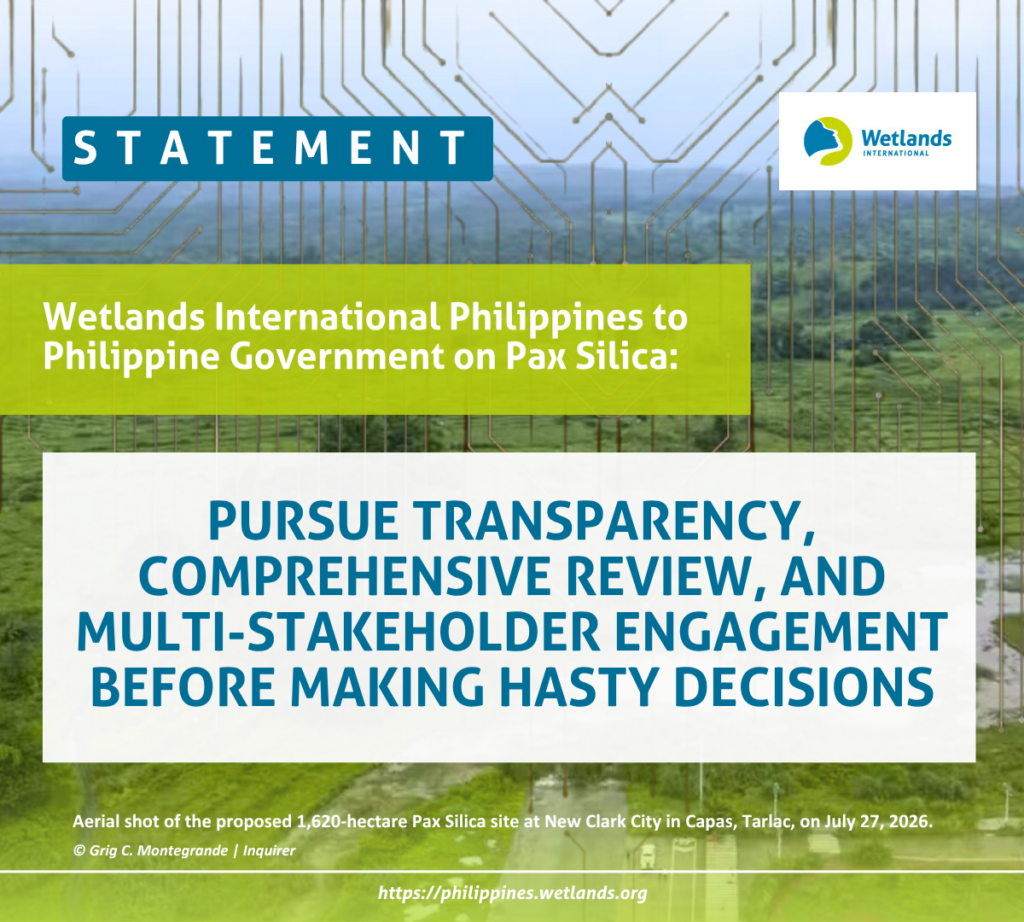
Wetlands International Philippines (WIP) urges the Philippine government to uphold the full tenets of transparency and engage all relevant stakeholders as it stands at the crux of pursuing a Pax Silica deal with the government of the United States of America.
As the partnership faces strong backlash from several sectors of society, Wetlands International Philippines calls for the full disclosure of all the details surrounding the Pax Silica deal as well as the independent, scientific, and comprehensive review of its environmental, social, and economic implications.
A 4,000-acre (1,618.74 hectares) industrial zone necessitates comprehensive review and multi-stakeholder consultation. Development projects as large as Pax Silica have the potential to significantly alter landscapes, including wetlands and watersheds, and the social structures of multiple communities and groups surrounding it.
Researchers from the Massachusetts Institute of Technology (MIT) have linked data centers to noise pollution, greater water consumption, strain on local infrastructure, poor power quality and blackout risks, unequal distribution of the benefits and burdens, and community exclusion from the decision-making process.
While government officials have asserted that existing water resources can accommodate the project and that energy will be sourced through renewable energy systems, the burden of proving that local water resources and energy recycling mechanisms can sustainably support the project without compromising communities and ecosystems must rest on project proponents and government agencies.
Beyond the data center itself, the mining and industrial components of the Pax Silica deal raise even deeper concerns as these could affect Philippine wetlands, watersheds, and local communities.
Wetlands and watersheds are not vacant lands awaiting development. They are critical natural infrastructure that sustains water security, reduces flooding, supports biodiversity, and strengthens climate resilience. Their protection is indispensable at a time when the Philippines faces growing climate threats, prolonged dry periods, and increasing pressure on freshwater resources.
Mining activities can alter landscapes, damage critical watersheds, disrupt natural hydrological systems, increase erosion and sedimentation, and degrade habitats that support wildlife and ecosystem functions.
The impacts are not confined to project sites. They can extend across entire landscapes, affecting communities that depend on clean water, productive farmlands, fisheries, and healthy ecosystems for their livelihoods and well-being.
The absence of a transparent, comprehensive, and landscape-level environmental and social impact assessment raises serious questions about whether the full cumulative impacts of the project have been adequately considered.
Decisions of this magnitude must not be made behind closed doors or evaluated in isolation.
The public deserves full disclosure of project agreements, environmental studies, water demand projections, and plans for mitigating impacts on ecosystems and communities.
Economic development should not come at the expense of natural systems that sustain life and prosperity.
As the country seeks to position itself as a hub for digital infrastructure and investment, it must ensure that growth does not undermine water security, ecosystem integrity, and climate resilience.
Call to Action
Wetlands International Philippines emphasizes that it is not opposed to technological innovation, digital infrastructure, or economic development. However, development must be pursued responsibly, transparently, and within ecological limits.
We therefore call on the Office of the President and relevant national agencies to immediately undertake a transparent, landscape-level, strategic environmental, social and economic assessment of the Pax Silica proposal before making hasty decisions that could have irreversible consequences. Such an assessment would examine the cumulative impacts of the proposed data center, mining operations, industrial expansion, water extraction, and energy consumption. It will also help the government assess and ensure the fair distribution of benefits to the affected local communities and indigenous peoples.
Likewise, we urge the National Water Resources Board, the Department of Environment and Natural Resources, the Bases Conversion and Development Authority, and other regulatory agencies to publicly disclose all agreements, technical studies, environmental assessments, and water resource analyses related to the project to ensure full public accountability.
Rather than pursuing a development pathway tied to resource-intensive and extractive industries, the Philippine government should prioritize investments in nature-positive development. This includes ecosystem restoration, renewable energy, sustainable agriculture, ecotourism, and green infrastructure that generate jobs, strengthen local economies, and enhance climate resilience while protecting natural resources.
Critical wetlands, watersheds, and biodiversity-rich areas must likewise be declared no-go zones for mining and other environmentally destructive activities.
If the government is intent on expanding digital infrastructure, it must pursue a national green data center strategy anchored on renewable energy, water-efficient cooling systems, circular water-use technologies, and site selection criteria that avoid ecologically sensitive areas.
We also call on local government units, scientists, academic institutions, civil society organizations, and affected communities to undertake an evidence-based review of the project’s potential impacts and to actively participate in public consultations.
Decisions that will shape the future of our wetlands, watersheds, and water security must not be made without meaningful public participation and informed consent from the communities that stand to bear the consequences.
The Philippines stands at a crossroads. We can pursue a model of development that safeguards our water resources, protects our wetlands, strengthens community resilience, and secures long-term prosperity, or we can choose a path that risks sacrificing irreplaceable ecosystems for short-term gains.
Wetlands International Philippines urges the government to choose a future that places people, nature, and sustainability at the center of national development.
Protect our wetlands. Safeguard our watersheds. Defend our communities. Secure our water future. Review the Pax Silica deal now.
References:
- Broken Promises: Philippines Nickel Mining Causes Rights Abuses and Increases Climate Vulnerability. Climate Rights International, 2025, https://cri.org/reports/broken-promises/
- Guidi, Gianluca, et al. Environmental Burden of United States Data Centers in the Artificial Intelligence Era. 2024. arXiv, arXiv:2411.09786, https://arxiv.org/abs/2411.09786.
- Intergovernmental Science-Policy Platform on Biodiversity and Ecosystem Services (IPBES). Global Assessment Report on Biodiversity and Ecosystem Services. IPBES Secretariat, 2019.
- Li, Pengfei, et al. “The Carbon and Water Footprints of Data Centers and What This Could Mean for AI.” Patterns, vol. 7, no. 1, 2026.
- Millennium Ecosystem Assessment. Ecosystems and Human Well-Being: Wetlands and Water Synthesis. World Resources Institute, 2005.
- Miller, J. R., & Hudson-Edwards, K. A. (2019). Mining and Environmental Health Disparities in Native American Communities. Current Environmental Health Reports, 6(4), 227-239.
- Ngata, Wacuka, et al. “The Cloud Next Door: Investigating the Environmental and Socioeconomic Strain of Datacenters on Local Communities.” Proceedings of the ACM SIGCAS/SIGCHI Conference on Computing and Sustainable Societies (COMPASS ’25), Association for Computing Machinery, 2025, https://doi.org/10.1145/3715335.3736324.
- Partidário, Maria do Rosário. Strategic Environmental Assessment Better Practice Guide. Portuguese Environment Agency, 2012.
- Ramsar Convention Secretariat. Global Wetland Outlook: State of the World’s Wetlands and Their Services to People. Ramsar Convention Secretariat, 2018.
- Sonter, Laura J., Saleem H. Ali, and James E. M. Watson. “Mining and Biodiversity: Key Issues and Research Needs in Conservation Science.” Proceedings of the Royal Society B: Biological Sciences, vol. 285, no. 1892, 2018, https://doi.org/10.1098/rspb.2018.1926.
- Timblique, Janica. Case Study: The Environmental and Social Costs of Illegal Mining in the Cordillera Region of the Philippines. SSRN, 2024.
- United Nations Environment Programme. Becoming Generation Restoration: Ecosystem Restoration for People, Nature and Climate. UNEP, 2021.
- You, Fengqi, et al. “Environmental Impact and Net-Zero Pathways for Sustainable Artificial Intelligence Expansion.” Nature Sustainability, 2025.