
GMAP Statement: Congressional Inquiry into DENR’s Mangrove Earth-balling and Relocation Memo
-
Mangroves
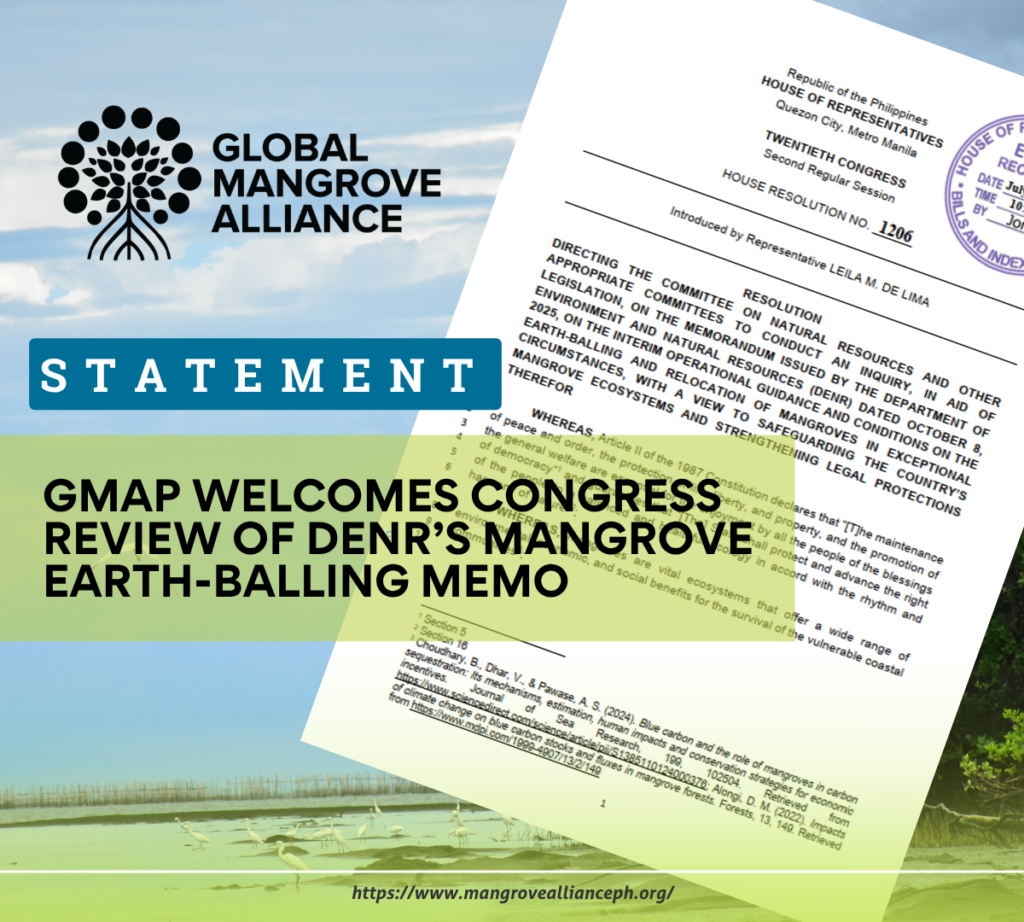
The Global Mangrove Alliance Philippines (GMAP) welcomes the recent Congressional directive to investigate the Department of Environment and Natural Resources’ (DENR) Memorandum on the Interim Operational Guidance and Conditions on the Earth-Balling and Relocation of Mangroves in Exceptional Circumstances.
We see this inquiry as an important opportunity to ensure that decisions affecting our mangroves are guided by science, existing environmental laws, the constitutional right of Filipinos to a balanced and healthful ecology, and the long-term welfare of our communities.
At a time when the Philippines is facing stronger typhoons, rising sea levels, declining fish catches, and worsening climate impacts, we cannot afford policies that may weaken the ecosystems that help protect our people.
As it is, the country’s mangroves continue to face pressures from development, land-use change, and other challenges. Any policy or operational guidance on mangrove removal and relocation should be carefully assessed. This means considering ecological realities, conservation objectives, and the long-term sustainability of these vital coastal ecosystems.
The memorandum has drawn widespread concern from environmental groups, scientists and coastal stakeholders because it creates a regulatory pathway for mangrove displacement under broadly defined “exceptional circumstances”.
The broad scope of these exceptions, particularly for nationally endorsed infrastructure projects, raises questions about how the policy may be interpreted and applied in practice. The policy is thus vulnerable to abuse.
Without clear scientific criteria, transparent safeguards, and independent oversight, what is intended to be an exceptional measure risks becoming routine practice. This would undermine the long-standing principle of avoiding impacts on mangrove ecosystems whenever possible.
The Congressional inquiry provides a timely opportunity to examine the scientific basis, ecological impacts, legal implications, governance issues, and socioeconomic consequences of allowing mangrove earth-balling and relocation as a mitigation measure and to take stock of how earth-balling permits have been issued and implemented both before and after the memorandum’s release in October 2025.
Mangroves are not barriers to development. They are critical natural infrastructure that protects coastal communities from storm surges, flooding, and erosion.
Mangroves sustain fisheries and food security. They support the livelihoods of approximately 1.4 to 1.5 million small-scale fisherfolk and coastal resource users. They store vast amounts of blue carbon. They strengthen the country’s resilience to climate change.
Sustainable development is best achieved not by removing these ecosystems, but by designing infrastructure that avoids impacts on mangroves and works with nature wherever feasible.
Science shows that mangrove forests are complex ecosystems whose functions depend on the interaction of vegetation, soils, tidal flows, and biodiversity.
Earth-balling relocates trees, not ecosystems. Even where transplanted trees survive, critical ecosystem services such as fisheries support, shoreline protection, carbon storage, and biodiversity conservation may be lost or take decades to recover.
Available evidence also indicates that successful earth-balling has been demonstrated primarily for young, small-diameter mangroves. Most trees affected by development projects are mature mangroves, making successful transplantation highly uncertain and ecologically risky.
Mangroves are among the world’s most carbon-rich ecosystems. Disturbing them through earth-balling or land development can release long-stored carbon while reducing one of the Philippines’ most effective nature-based solutions for climate change.
Mangrove management should likewise be consistent with the Philippines’ commitments under the Paris Agreement, the Kunming-Montreal Global Biodiversity Framework, and the Ramsar Convention on Wetlands.
While infrastructure development is essential, it must be guided by sound science, transparency, and public accountability. Consistent with the mitigation hierarchy in development programs, impacts on mangroves should first be avoided.
Earth-balling and relocation should not become a substitute for avoiding impacts on ecologically significant mangrove ecosystems.
We therefore call on Congress to conduct a comprehensive, transparent, science-based, and participatory inquiry that involves scientists, fisherfolk, Indigenous Peoples, local governments, civil society, and other stakeholders.
In the spirit of precaution, and in support of this inquiry, GMAP respectfully requests that Congress consider calling on DENR to suspend the implementation of the memorandum, or place it under a moratorium, while the inquiry is ongoing. This would allow the scientific, legal, and governance questions surrounding the policy to be fully examined and resolved before any further earth-balling and relocation activities proceed under its provisions.
Specifically, we urge Congress to examine:
- the scientific evidence on the effectiveness and long-term ecological impacts of mangrove earth-balling and relocation;
- whether the definition of “exceptional circumstances” is sufficiently clear and narrowly applied;
- whether the memorandum is consistent with existing environmental laws, the Constitution, DENR’s mangrove policies, and the country’s international commitments;
- a review of mangrove earth-balling permits issued both prior to and following the release of the DENR Memorandum in October 2025, to better understand outcomes for transplanted mangroves and to identify opportunities to strengthen permit conditions, monitoring, and compliance going forward; and
- the volume, location, and outcomes of mangrove earth-balling permits issued both before and after the DENR Memorandum’s release in October 2025
- whether stronger safeguards, monitoring, and accountability measures are needed to protect mangrove ecosystems.
The outcome of this inquiry will have lasting implications for the future of the Philippines’ coastal ecosystems and the communities that depend on them.
GMAP remains committed to supporting evidence-based policymaking that advances sustainable development while safeguarding the country’s invaluable mangrove ecosystems for the present and future generations.