

Mangrove Restoration: Planting is not enough
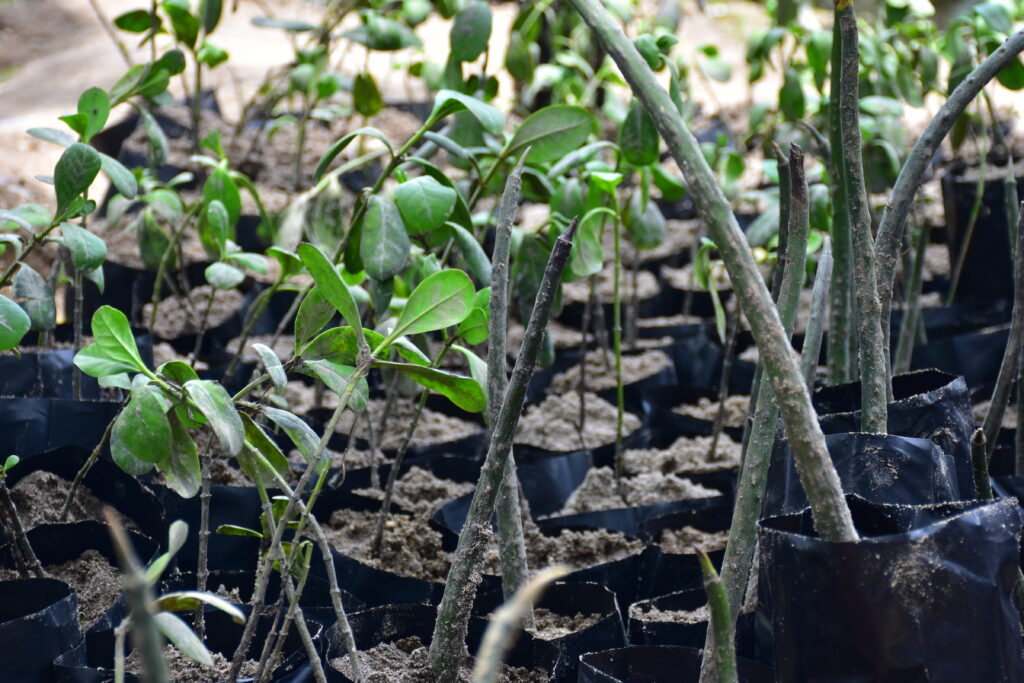
The Philippines has an expansive distribution of mangroves throughout the archipelago. Estimates from the Philippine Statistics Authority (PSA) puts this at 311,216 hectares in 2020, amounting to a linear coverage of one-third of the Philippine coastline (Bunting et al, 2022).
When mangroves make up such a large extent of a country’s coastline, their importance is a lot more perceptible.
Given its proximity to the ocean, the Philippines is especially prone to typhoons, floods, storm surges, and coastal erosion. Mangroves serve as a natural barrier against these types of disasters, absorbing much of the impact through their complex root systems.
Mangrove forests are also important sources of livelihood and biodiversity. They provide a safe habitat and breeding ground for many fish, crustaceans, birds, and other marine species, allowing for a thriving coastal ecosystem. Many nearby communities depend on mangroves to support local industries such as fisheries, aquaculture, and timber production.
Alongside this, mangroves are essential for climate action, especially for a country greatly affected by climate change. They are highly efficient carbon sinks, capable of storing up to four times more carbon than other tropical forests (USDA Forest Service, 2011).
Yet it seems that the value mangroves bring goes largely unnoticed by many Filipinos.
The cover of mangrove forests in the Philippines has declined significantly in the last 100 years. According to Wetlands International (2025), the country has lost more than 64% of its previously existing mangroves since 1918.
This can be largely attributed to human intervention. Many forests are chopped down, often to extract resources like timber, or to redevelop the land into fish ponds that may go unused and abandoned after years of misuse.
What then can we do about this?
The solution partly lies in mangrove rehabilitation. The process of rehabilitation aims to repair a damaged ecosystem back to a functional state. This should not be confused with the process of restoration, which seeks to return an ecosystem to its original state. The priority of rehabilitation is functionality.
While it can be a good start to mangrove rehabilitation, tree planting is not enough. Some tree species are not suitable for saline and estuarine environments. Meanwhile, other species can even be harmful to the local ecosystem.
Beyond this, trees, let alone mangroves, require constant maintenance during development, as saplings are especially vulnerable to natural disasters. If the trees don’t survive, then the forest will continue to remain a damaged ecosystem. A high survival rate is crucial for effective mangrove rehabilitation efforts.
That call is more urgent now than ever.
As individuals, we can start by critically examining the environmental campaigns we participate in or support. Asking not just how many trees were planted, but how many survived, and who is tending to them. We can amplify science-based restoration advocacy, support organizations working at the intersection of ecology and community development, and hold ourselves accountable to the ecosystems we claim to protect.
Collectively, we must push for stronger policy. Bills that enshrine science-based standards for mangrove rehabilitation, ones that tie funding and recognition to measurable ecological outcomes, not seedling headcounts. Legislation that protects existing mangrove cover from further conversion is equally critical. What has not yet been lost is always easier to protect than what must be rebuilt.
The Philippines has already lost too much of its mangrove cover to afford another century of well-meaning but ineffective action. Today, let us commit not just to planting trees, but to understanding what it truly means to restore them.
Watch Wetlands International’s Mangrove Restoration Series


To learn more about ecological mangrove restoration, also check the Global Mangrove Alliance’s ‘Best Practice Guidelines for Mangrove Restoration’.
References
- Bunting, P., Rosenqvist, A., Hilarides, L., Lucas, R. M., Thomas, N., Tadono, T., Worthington, T. A., Spalding, M., Murray, N. J., & Rebelo, L.-M. (2022). Global Mangrove Extent Change 1996–2020: Global Mangrove Watch Version 3.0. Remote Sensing, 14(15), 3657. https://doi.org/10.3390/rs14153657
- Philippine Statistics Authority. (2025, December 22). Highlights of the Mangrove Accounts of the Philippines: Extent Accounts 2015 to 2020. https://psa.gov.ph/system/files/enrad/Mangrove%20Extent%20Accounts%20Highlights.pdf
- Hermes, E. (2024, March 26). Mangrove crisis in the Philippines. https://storymaps.arcgis.com/stories/2c2a33011afa4948906825e98b42e44d
- Lu, B. J. (2024, May 31). The importance of Philippine mangroves. Philippine News Agency. https://www.pna.gov.ph/opinion/pieces/888-the-importance-of-philippine-mangroves
- Wetlands International. (2025, March 18). Scaling science-based mangrove restoration in the Philippines. https://www.wetlands.org/case-study/scaling-science-based-mangrove-restoration-in-the-philippines/
- USDA Forest Service, Pacific Southwest Research Station. (2011, April 5). Mangroves among the most carbon-rich forests in the tropics; Coastal trees key to lowering greenhouse gases. ScienceDaily. www.sciencedaily.com/releases/2011/04/110404173247.htm
About the Authors
Gwen Salespora studies Development Communication at the University of the Philippines Los Baños, with interests in community development, environmental communication, and participatory development journalism. Her work centers on local communities, culture, the arts, and social issues, driven by the belief that communication can be a meaningful force for advocacy and change.
Yosh Matthew Miguel studies AB Communication at the Ateneo de Manila University. His passions are mainly in film and animal welfare. He also intends to pursue a career as an educator.